Sunday, April 13, 2014

Mantra
Mantra (Sanskrit) means a sacred utterance, numinous sound, or a syllable, word, phonemes, or group of words believed by some to have psychological and spiritual power. Mantra may or may not be syntactic or have literal meaning; the spiritual value of mantra comes when it is audible, visible, or present in thought.
Earliest mantras were composed in Vedic times by Hindus in India, and those are at least 3000 years old. Mantras are now found in various schools of Hinduism, Buddhism, Jainism and Sikhism. Similar hymns, chants, compositions and concepts are found in Zoroastrianism, Taoism, Christianity and elsewhere.
The use, structure, function, importance and types of mantras vary according to the school and philosophy of Hinduism and of Buddhism. Mantras serve a central role in the tantric school of Hinduism. In this school, mantras are considered equivalent to deities, a sacred formula and deeply personal ritual, and considered to be effective only after initiation. However, in other schools of Hinduism, Buddhism, Jainism or Sikhism, this is not so.

Mantras come in many forms, including ṛc (verses from Rigveda for example) and sāman (musical chants from the Sāmaveda for example). They are typically melodic, mathematically structured meters, resonant with numinous qualities. At its simplest, the word (Aum, Om) serves as a mantra. In more sophisticated forms, they are melodic phrases with spiritual interpretations such as human longing for truth, reality, light, immortality, peace, love, knowledge and action.  In other forms, they are literally meaningless, yet musically uplifting and spiritually meaningful.


http://en.wikipedia.org/wiki/Mantra

Thursday, March 27, 2014

1) Make it a formal practice. You will only get to the next level in meditation by setting aside specific time (preferably two times a day) to be still.
2) Start with the breath. Breathing deep slows the heart rate, relaxes the muscles, focuses the mind and is an ideal way to begin practice.

3) Stretch first. Stretching loosens the muscles and tendons allowing you to sit (or lie) more comfortably. Additionally, stretching starts the process of “going inward” and brings added attention to the body.
4) Meditate with Purpose. Beginners must understand that meditation is an ACTIVE process. The art of focusing your attention to a single point is hard work, and you have to be purposefully engaged!
5) Notice frustration creep up on you. This is very common for beginners as we think “hey, what am I doing here” or “why can’t I just quiet my damn mind already”. When this happens, really focus in on your breath and let the frustrated feelings go.
6) Experiment. Although many of us think of effective meditation as a Yogi sitting cross-legged beneath a Bonzi tree, beginners should be more experimental and try different types of meditation. Try sitting, lying, eyes open, eyes closed, etc.
7) Feel your body parts. A great practice for beginning meditators is to take notice of the body when a meditative state starts to take hold. Once the mind quiets, put all your attention to the feet and then slowly move your way up the body (include your internal organs). This is very healthy and an indicator that you are on the right path.
8) Pick a specific room in your home to meditate. Make sure it is not the same room where you do work, exercise, or sleep. Place candles and other spiritual paraphernalia in the room to help you feel at ease.
9) Read a book (or two) on meditation. Preferably an instructional guide AND one that describes the benefits of deep meditative states. This will get you motivated. John Kabat-Zinn’s Wherever You Go, There You Are is terrific for beginners.
10) Commit for the long haul. Meditation is a life-long practice, and you will benefit most by NOT examining the results of your daily practice. Just do the best you can every day, and then let it go!
11) Listen to instructional tapes and CDs.
12) Generate moments of awareness during the day. Finding your breath and “being present” while not in formal practice is a wonderful way to evolve your meditation habits.
13) Make sure you will not be disturbed. One of the biggest mistakes beginners make is not insuring peaceful practice conditions. If you have it in the back of your mind that the phone might ring, your kids might wake, or your coffee pot might whistle than you will not be able to attain a state of deep relaxation.
14) Notice small adjustments. For beginning meditators, the slightest physical movements can transform a meditative practice from one of frustration to one of renewal. These adjustments may be barely noticeable to an observer, but they can mean everything for your practice.
15) Use a candle. Meditating with eyes closed can be challenging for a beginner. Lighting a candle and using it as your point of focus allows you to strengthen your attention with a visual cue. This can be very powerful.
16) Do NOT Stress. This may be the most important tip for beginners, and the hardest to implement. No matter what happens during your meditation practice, do not stress about it. This includes being nervous before meditating and angry afterwards. Meditation is what it is, and just do the best you can at the time.
17) Do it together. Meditating with a partner or loved one can have many wonderful benefits, and can improve your practice. However, it is necessary to make sure that you set agreed-upon ground rules before you begin!
18) Meditate early in the morning. Without a doubt, early morning is an ideal
time to practice: it is quieter, your mind is not filled with the usual clutter, and there is less chance you will be disturbed. Make it a habit to get up half an hour earlier to meditate.
19) Be Grateful at the end. Once your practice is through, spend 2-3 minutes feeling appreciative of the opportunity to practice and your mind’s ability to focus.
20) Notice when your interest in meditation begins to wane. Meditation is
hard work, and you will inevitably come to a point where it seemingly does not fit into the picture anymore. THIS is when you need your practice the most and I recommend you go back to the book(s) or the CD’s you listened to and become re-invigorated with the practice. Chances are that losing the ability to focus on meditation is parallel with your inability to focus in other areas of your life!
Meditation is an absolutely wonderful practice, but can be very difficult in the beginning. 

Wednesday, March 19, 2014

Meditation For Beginners


The goal of meditation is to focus and quiet your mind, eventually reaching a higher level of awareness and inner calm. It may come as a surprise to learn that you can meditate anywhere and at any time, allowing yourself to access a sense of tranquility and peace no matter what's going on around you. This article will introduce you to the basics of meditation, allowing you to begin your journey on the path of enlightenment.


Part 1 of 3: Prepare to Meditate


1.   Choose a peaceful environment. 


Meditation should be practiced somewhere calming and peaceful. This will enable you to focus exclusively on the task at hand and avoid bombarding your mind with outside stimuli. Try to find somewhere that you will not be interrupted for the duration of your meditation - whether it's five minutes or half an hour. The space does not need to be very large - a walk-in closet or even your office can be used for meditation, as long as it's somewhere private.
Ø For those new to meditation, it's especially important to avoid any external distractions. Turn off TV sets, the phone or other noisy appliances. If you play music, choose calm, repetitive and gentle tunes, so as not to break your concentration. Another option is to turn on a small water fountain - the sound of running water can be extremely calming.

Ø Understand that the meditation space does not need to be completely silent, so there should be no need to reach for the earplugs. The sound of a lawnmower running or the dog barking next door shouldn't prevent effective meditation. In fact, being aware of these noises but not letting them dominate your thoughts is an important component of successful meditation.

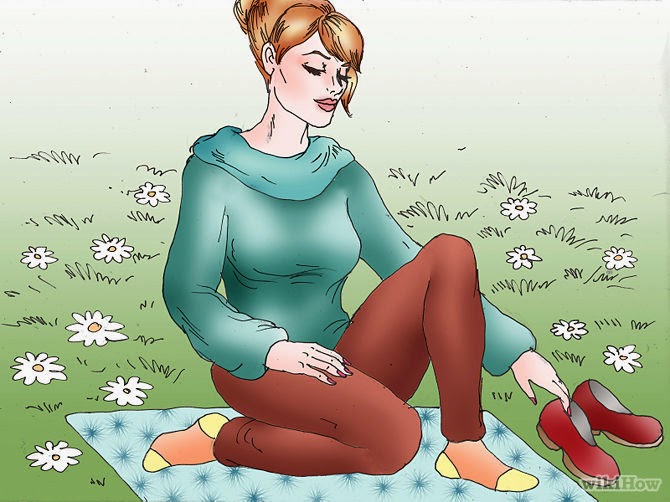
Ø Meditating outside works for many meditators. As long as you don't sit near a busy roadway or another source of loud noise, you can find peace under a tree or sitting upon some lush grass in a favourite corner of the garden.


2.  Wear comfortable clothes


One of the major goals of meditation is to calm the mind and block out external factors- however, this can be difficult if you feel physically uncomfortable due to tight or restrictive clothing. Try to wear loose clothing during meditation practice and make sure to remove your shoes.
·        Wear a sweater or a cardigan if you plan on meditating someplace cool. If you don’t the sensation of being cold will consume your thoughts and you will be tempted to cut your practice short.
·        If you are somewhere that you can’t easily change your clothes, do your best to make yourself as comfortable as possible. Take off your shoes and jacket, open the collar of your shirt or blouse, remove your belt or enjoy being in your Baju-Kurong.

3.  Decide how long you want to meditate for.


Before you begin, you should decide how long you are going to meditate for. While many seasoned meditators recommend twenty minute sessions twice a day, beginners can start out doing as little as five minutes, once a day.

·         You should also try to meditate at the same time each day - whether it's 15 minutes first thing in the morning, or 5 minutes on your lunch hour. Whatever time you choose, try to make meditation an unshakable part of your daily routine.
·         Once you have decided on a time frame, try to stick to it. Don't just give up because you feel like it isn't working - it will take time and practice to achieve successful meditation - right now, the most important thing is to keep trying.

·         Although you will want to keep track of your meditation time, it is not beneficial to be constantly checking your watch. Think about setting a gentle alarm to alert you when your practice is up, or time your practice to end with a certain event - such as your partner getting out of bed, or the sun hitting a certain spot on the wall.


"Stay tuned for more"